
 Türkçe (TR)

Laser Treatment for Hyperopia and Latest Technologies Used
What is Hyperopia?
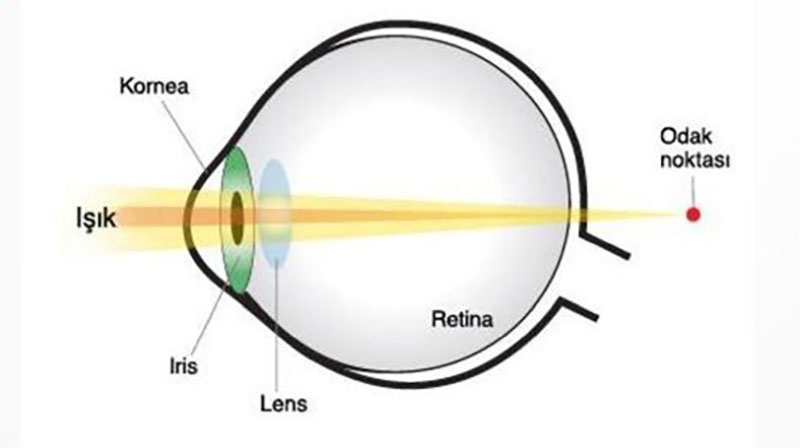
When light rays enter our eyes, they are refracted as they pass through different parts of the eye and focus on a point on the retina. If there is a disruption in this refraction process due to the structures of the eye, the rays cannot focus on the correct point, and refractive errors of the eye occur. If a person cannot see distant objects clearly, it is called myopia or nearsightedness, and if they cannot see close objects clearly, it is called hyperopia or farsightedness. Astigmatism, where objects at all distances cannot be seen clearly, and presbyopia, where near objects cannot be seen clearly due to aging, are other refractive errors.
In hyperopia, the eyeball is horizontally shorter than normal, or the cornea is not as curved as it should be. As a result, the rays focus slightly behind the retina instead of on it. The main goal of hyperopia treatment is to bring this focal point back onto the retina.
Hyperopia is usually hereditary, but it can occur in anyone. Symptoms may appear in childhood, but they are more likely to appear later in life. The most important of the symptoms of hyperopia is not being able to see close objects clearly. Vision becomes blurred, and eyes may become crossed in children. A person with hyperopia tries to squint to see better. This constant effort can lead to headaches after a while. In addition, fatigue, pain, and burning sensations in the eyes are also possible symptoms.
Different methods of hyperopia treatment are available. The most appropriate treatment method varies from person to person depending on age, lifestyle, and preferences. The most common and generally the first method applied is the use of glasses. Glasses will be the most appropriate treatment, especially for patients who are not old enough for surgery and are too young to take responsibility for contact lens use. Thin-edged lenses are used in hyperopia treatment in glasses. Thus, the rays entering the eye are collected at a point further forward. Features such as anti-reflection can also be preferred in spectacle lenses.
Another hyperopia treatment is the use of contact lenses. Some contact lenses are used daily and discarded at the end of the day. Others are placed in a special solution every night and cleaned. These are usually replaced with new lenses after a period of 1 month. Your doctor will inform you about the correct use of lenses while determining whether lens use is appropriate for you.
The only permanent method of hyperopia treatment is surgery. Hyperopia treatments have been successfully performed with the Lasik method by Op. Dr. Sinan Göker for nearly 20 years. Initially, interventions could be performed on eyes up to 4 diopters, but later it was applied up to 5-6 diopters. Finally, hyperopia up to 7 diopters is treated with a 90% success rate. Hyperopia over 5 diopters can be treated in a limited number of clinics in the world. During the operation performed with the laser method, the shape of the cornea of the eye is intervened. The refractive power is adjusted by changing the slope of the cornea. Thus, the eye can refract the incoming rays correctly without the need for any lens. The most common type of laser eye surgery is LASIK surgery, which has a very high success rate. It is applied to people who are 18 years of age and whose eye structure (corneal thickness) is suitable for laser.
During LASIK surgery, a layer called a flap is lifted on the cornea of the eye, but not removed. The doctor intervenes under this layer. The curvature of the cornea is increased and made to refract light more. Afterwards, the opened flap is closed and the operated eye heals under its own layer. Since there is no stitch to be taken or a large incision, the risk of infection and complications after surgery is quite low. Methods such as no-touch and smile are not effective in hyperopia.
The first thing to do for LASIK surgery in hyperopia surgery is to find an experienced and reliable doctor. This is important both for the quality of the result and for you to feel comfortable during the surgery. Your doctor will first evaluate whether your eye is suitable for laser surgery by performing the necessary examinations and measurements. Sometimes the dryness of the eye, sometimes the thickness of the cornea affects the suitability of the eye for surgery. If you are suitable for the operation, the next stage is passed.
Before LASIK surgery, the patient is usually given a sedative to relax and the eye is locally anesthetized with drops. The patient is awake during surgery. The eyelids are opened and fixed, and the eye is intervened with a laser. The patient does not feel any pain or ache. The only discomfort is looking at an intense light for a while. Therefore, in the hands of a reliable doctor, LASIK surgery is one of the easiest operations for the patient.
After the surgery, your doctor examines your eye the next day and one month later and monitors the healing process. He/she will give you various drops to use during this period. These prevent infection in the eye and help the healing process. Possible side effects of the surgery include light flashes, halos, or dry eyes for a while.
Depending on the degrees of hyperopia or if it is not suitable for laser eye surgery, an artificial lens can be placed inside the eye with phakic intraocular lens surgery. Thus, a clear image can be obtained in near objects without the need for glasses or contact lenses.
As age progresses, the complaint of not being able to see near occurs due to different deteriorations in the structures of the eye and is not hyperopia. In general, a person begins to notice presbyopia symptoms after the age of 40. Since the development process is different, the treatment principles will also be different from hyperopia. Dr. Sinan Göker has been applying multifocal lenses, which are recently called smart lenses among the public, in the treatment of presbyopia for nearly 20 years.
Frequently asked questions:
How is hyperopia surgery performed?
Hyperopia surgery is performed with Excimer Laser LASIK technique or with intraocular lens application according to the examination result and age. A personalized treatment plan is made according to the patient's eye structure.
Up to how many diopters can hyperopia be treated?
Hyperopia treatment is a difficult treatment. Although laser treatment has been performed for many years, the success rate was low in very high numbers. However, in recent years, high-numbered hyperopia have been successfully treated with laser at Dr. Sinan Göker Eye Group. In our clinic, hyperopia up to 7 diopters can be successfully treated with laser.
How is hidden hyperopia understood?
It is understood by detailed eye examination with drops.
Is there a high hyperopia that cannot be treated with laser?
Yes, there is. Intraocular lens application is performed in high numbers that are not suitable for laser or cannot be treated with laser. (ICL)
Medical Information & Disclaimer
The content on this page is for informational purposes only. The information contained herein should not be used as a substitute for professional medical advice, diagnosis, or treatment by an ophthalmologist. Always seek the advice of a physician or other qualified health provider with any questions you may have regarding a medical condition.