
 Türkçe (TR)

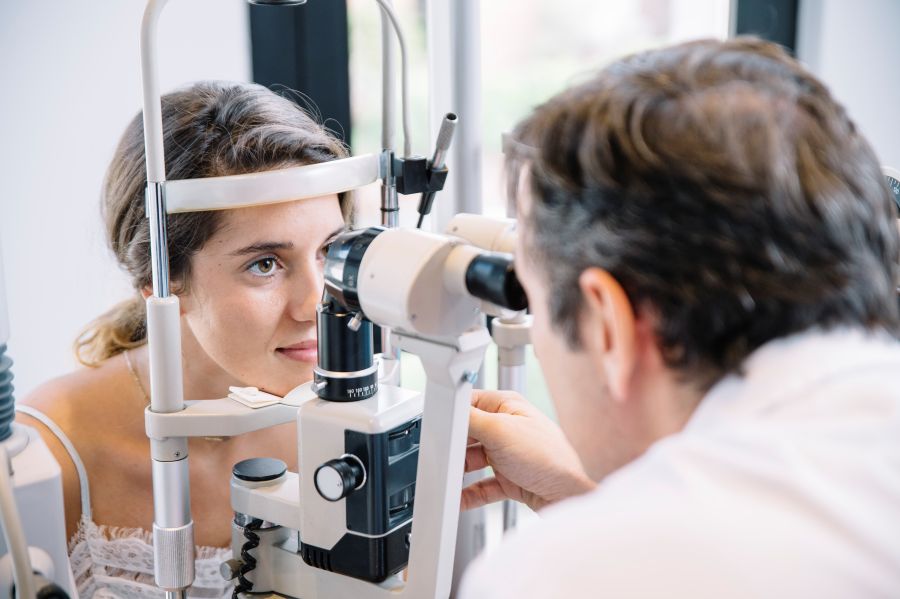
Everything You Need to Know About Eye Surgery

In this comprehensive guide, you can find the most frequently asked questions and all the details you need to know about eye surgery, with the expertise of Dr. Sinan Göker. This article will guide those considering eye surgery in their decision-making process.
The Importance of Eye Health and Modern Treatment Methods
Eye health is one of our most critical senses, directly affecting our overall quality of life. Today, thanks to advances in medical technology, many vision defects and eye diseases can be treated effectively. Eye surgeries are at the forefront of these modern treatment methods, allowing millions of people to achieve clearer and healthier vision.
On this page, we will discuss in detail the basic information about laser eye surgeries (such as LASIK, PRK, SMILE), cataract treatment, and other common eye operations, who they are suitable for, potential risks, expected benefits, and recovery processes.
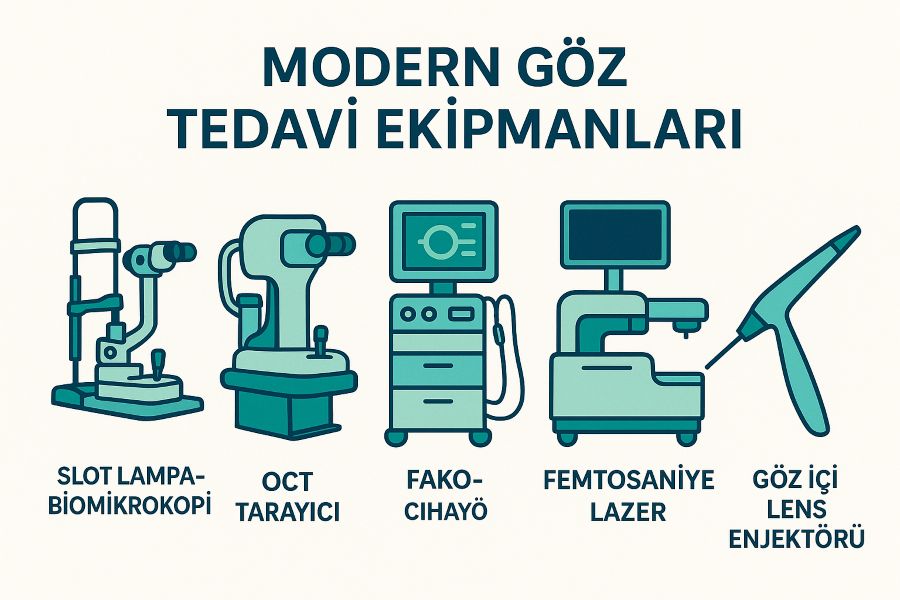
Image: Modern Eye Treatment Equipment
Major Types and Methods of Eye Surgery
1. Laser Eye Surgeries (Refractive Surgery)
These are the most frequently used methods to correct refractive errors such as myopia (nearsightedness), hyperopia (farsightedness), and astigmatism (blurred or distorted vision). By reshaping the cornea with a laser, light is focused correctly onto the retina.
- LASIK (Laser-Assisted In Situ Keratomileusis): One of the most popular methods. A thin flap is created in the cornea, the underlying tissue is treated with an excimer laser, and the flap is repositioned. Offers a fast recovery process.
- PRK (Photorefractive Keratectomy): After the top layer of the cornea (epithelium) is removed, an excimer laser is applied. No flap is created. Recovery may take a little longer than LASIK, but it may be suitable for patients with thin corneas.
- SMILE (Small Incision Lenticule Extraction): A small lenticule (disc-shaped tissue) is created inside the cornea using a femtosecond laser, and this lenticule is removed through a very small incision. It is a flapless method.
- No-Touch Laser (TransPRK): A PRK variation where the epithelium is removed with a laser without any contact with the eye, and then the refractive error is corrected.
Image: Laser Eye Surgery Illustration
2. Cataract Surgery
It is usually a condition where the lens of the eye loses its transparency and becomes cloudy, often due to age. In cataract surgery, the cloudy natural lens is removed and replaced with an artificial intraocular lens (monofocal, multifocal, or trifocal/smart lens). Today, it can be performed seamlessly and quickly with the phacoemulsification (PHACO) technique.
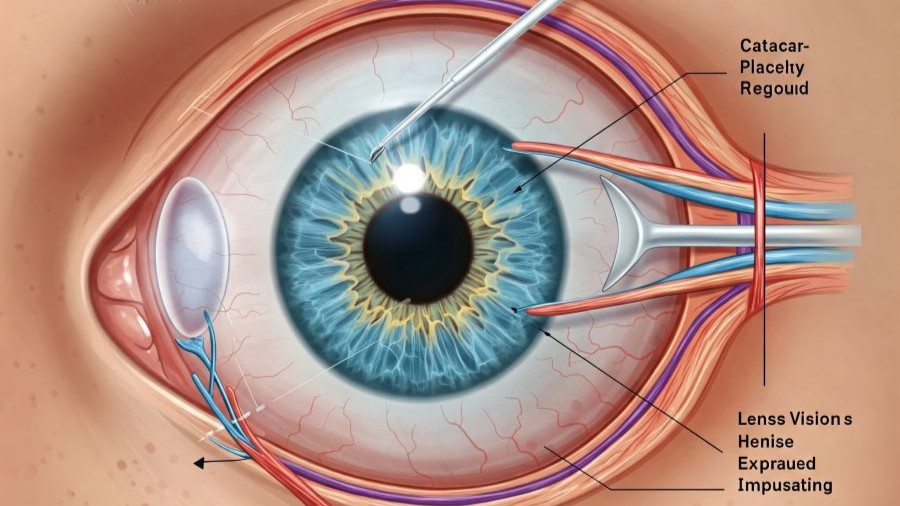
Image: Cataract Surgery and Intraocular Lens
3. Smart Lens (Trifocal/Multifocal Intraocular Lens) Applications
It is applied during cataract surgery or in suitable patients (usually over 40-45 years old) who do not have cataracts but want to solve near and far vision problems at the same time, with clear lens exchange (refractive lens exchange). Thanks to these lenses, patients can have both distance, intermediate and near vision without glasses.
4. Other Eye Surgeries
There are also many different types of eye surgeries, such as glaucoma (eye pressure) surgeries, strabismus surgeries, vitreoretinal surgeries for retinal detachment and other retinal diseases, and corneal transplantation (keratoplasty).
Who is Suitable for Laser Eye Surgery?
Although laser eye surgeries are an effective solution for many people to eliminate their dependence on glasses and lenses, they may not be suitable for everyone. The main criteria considered in determining suitable candidates are:
- Age: Generally being 18 years old (in some cases 21 years old). Although there is no upper age limit, additional conditions such as cataracts are evaluated.
- Stability of Eye Numbers: No significant change in eye numbers (usually more than 0.50 - 0.75 diopters) in the last 1 year.
- General Eye Health: Absence of certain eye diseases such as active eye infection, severe dry eye, uncontrolled glaucoma, and keratoconus.
- Corneal Thickness and Structure: The corneal thickness must be sufficient for the planned laser treatment.
- Systemic Diseases: Some systemic conditions such as uncontrolled diabetes and rheumatic diseases may prevent laser treatment.
- Pregnancy and Breastfeeding: Laser treatment is generally not applied to pregnant or breastfeeding women; these periods are expected to end.
In order to make the most accurate decision, it is essential to undergo a detailed eye examination by an experienced ophthalmologist and have all the tests performed.
Surgery Process, Aftermath, and Possible Risks
Pre-Surgery Preparation
For patients who are found suitable for surgery after detailed examination and tests, the surgery day is planned. Contact lens users are asked to stop using lenses for a certain period before the surgery (1 week for soft lenses, 3-4 weeks for hard lenses). No makeup should be applied on the day of the surgery, and perfume should not be used.
During Surgery
Laser eye surgeries usually take a few minutes for each eye. Since the eyes are numbed with anesthetic drops, no pain is felt. The patient is asked to focus on a light in the laser device during the procedure. Modern laser devices have the ability to track eye movements, which increases safety.
Post-Surgery Recovery and What to Pay Attention To
In the first few hours after the surgery, there may be complaints such as blurred vision, stinging, burning, and watering. It is important to use the drops given by your doctor regularly, not to rub your eyes, and not to let water get into your eyes in the first few days. While it is usually possible to return to daily activities the day after LASIK, recovery after PRK may take a little longer. The settling of full visual acuity varies from person to person and according to the method.
- Using protective glasses or a visor.
- Avoiding heavy sports, swimming, and sauna-like activities for a certain period.
- Not wearing makeup (especially around the eyes).
- Not skipping control appointments.
Possible Risks and Complications
As with any surgical procedure, eye surgeries have some risks. However, thanks to today's technology and experienced surgeons, these risks are quite low. Possible risks include:
- Infection (very rare)
- Dry eye (usually temporary)
- Light sensitivity, glare, seeing halos (usually decreases over time)
- Not fully resetting the number or a slight return (rarely requires additional intervention)
- Flap-related complications (very rare in LASIK)
It is important to discuss all possible risks and benefits in detail with your doctor before the surgery.
Eye Surgery Prices
Eye surgery prices vary depending on many factors. These factors include:
- The type of surgery to be performed (LASIK, PRK, SMILE, Cataract, Smart Lens, etc.)
- The modernity of the laser technology and devices used
- Personalized treatment planning (e.g., Wavefront, Femtosecond Laser use)
- The standards and services offered by the center where the surgery is performed
- The surgeon's experience and expertise
- Additional examination and treatment requirements
Therefore, in order to get clear price information, you must first undergo a detailed eye examination and discuss your treatment options with your doctor. After the most suitable treatment method for you is determined in our clinic, detailed information about current pricing will be provided.
Your Doctor: Op. Dr. Sinan Göker

Op. Dr. Sinan Göker is one of Turkey's leading ophthalmologists with many years of experience in the field of eye diseases and surgery. Having performed thousands of successful eye surgeries, Dr. Göker specializes in refractive surgery (laser treatments) and cataract surgery.
Known for his patient-oriented approach, closely following current technologies, and commitment to ethical values, Dr. Sinan Göker aims to offer each of his patients the most appropriate treatment solutions for their individual needs.
Learn more about Dr. Sinan Göker →Frequently Asked Questions (FAQ)
Laser eye surgery is generally suitable for individuals who are 18 years of age or older, whose eye numbers have not changed in the last year (usually not increased by more than 0.50 diopters), who have refractive errors such as myopia, hyperopia, or astigmatism, and whose general eye health is suitable. Factors such as corneal thickness, dry eye, and retinal health are also evaluated. Your doctor will make the final decision after a detailed examination.
What is the recovery process like after eye surgery?The recovery process varies depending on the type of surgery performed. For example, recovery after LASIK is usually faster, and patients may start to see clearly the next day. In PRK, there may be stinging and burning for the first few days, and full visual acuity may take a few weeks. It is very important to use the drops given by your doctor regularly and follow the recommendations.
Is laser eye surgery a painful procedure?No pain is felt during laser eye surgery because the eyes are numbed with anesthetic drops. There may be mild stinging, burning, and watering discomfort in the first few hours or days after the surgery, but these can usually be controlled with painkillers.
Will I need to wear glasses after eye surgery?The main goal of laser eye surgeries is to eliminate dependence on glasses and lenses. After a successful surgery, patients do not need glasses in their daily activities. However, after this operation, as age progresses, a reading glass may be needed as it happens to everyone when age-related near vision problem (presbyopia) develops.
When can I drive after surgery?This depends on the type of surgery performed and your recovery rate. You can usually start driving the next day or within a few days after LASIK. This period may be a little longer after PRK. Your doctor will inform you when you can safely drive.
When will I start seeing clearly after cataract surgery?Vision usually improves significantly the very next day after cataract surgery. However, it may take a few weeks to reach the best possible vision level and for the eye to adapt to the new lens. Your doctor's check-ups and recommendations are important during this process.
Take the First Step Towards Healthy Vision!
If you have questions about your eye health or are considering eye surgery, please do not hesitate to contact our expert team. Contact us to get information about treatment options specific to you and to make an appointment.
Medical Information & Disclaimer
The content on this page is for informational purposes only. The information contained herein should not be used as a substitute for professional medical advice, diagnosis, or treatment by an ophthalmologist. Always seek the advice of a physician or other qualified health provider with any questions you may have regarding a medical condition.