
 Türkçe (TR)

Corneal Transplantation (Keratoplasty)

Corneal Transplantation (Keratoplasty) is successfully applied in patients where contact lenses fail. The avascular structure of the cornea increases the success rate of this method. The reported success rate in this surgery varies between 93%-96%. Approximately 20% of patients with keratoconus require corneal transplantation during their lifetime. Despite the development of surgical techniques, visual recovery after surgery takes 6 months or longer. Leaving sutures in the cornea for a very long time is the most important factor in prolonging this period. Indications for surgery include failure with contact lenses, central scar affecting vision, and poor vision despite contact lenses. Despite the high success rate of the surgery, patients should be aware that sutures can cause high astigmatism and affect vision. Sutures are usually removed at the end of the first year, depending on the astigmatic effect. Even if all sutures are removed, significant myopia or astigmatism may remain in 50% of patients. Residual myopia or astigmatism can be reduced with excimer laser procedures such as LASIK or arcuate keratotomy (corneal relaxing incisions). For this, all sutures must be removed at least 6 months in advance. Complications following corneal transplantation are rare and include tissue rejection, astigmatism, dilated pupil, and recurrence of keratoconus. Tissue rejection is rare and can be reversed if treatment is started early.
|
|
|
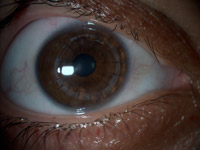
Appearance after corneal transplantation (early period) |
Medical Information & Disclaimer
The content on this page is for informational purposes only. The information contained herein should not be used as a substitute for professional medical advice, diagnosis, or treatment by an ophthalmologist. Always seek the advice of a physician or other qualified health provider with any questions you may have regarding a medical condition.