Türkçe (TR)

Corneal Crosslinking

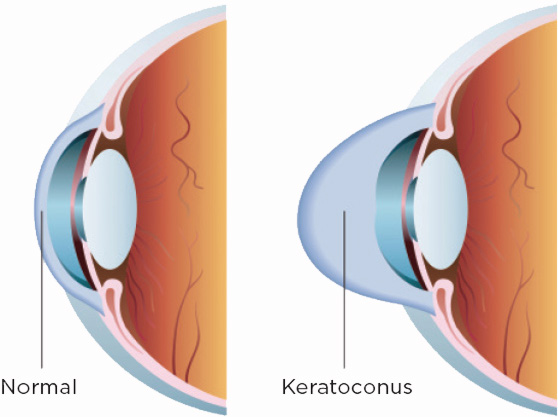
Corneal Crosslinking (C3-R®), a newer treatment method, aims to stop the progression of keratoconus. Although contact lenses can improve vision in keratoconus, they cannot stop its progression. In fact, sometimes contact lenses can cause microtraumas and indirectly contribute to the progression of keratoconus. This non-surgical method uses Ultraviolet A (UVA, 365nm) radiation and riboflavin (Vitamin B2). This method increases the collagen cross-links that make up the natural bonds of the cornea. Apoptosis (cell death) develops due to UV radiation, and dead cells are replaced by healthier cells. Roughly speaking, diseased cells are eliminated, allowing the formation of new and healthier cells.
|
|
|
|
|
After treatment, an increase in cross-links between collagens is observed. |
||
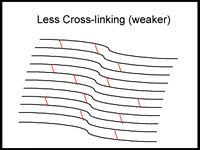
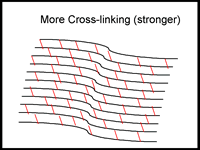
As the bonds tighten, the risk of corneal deformation decreases. The effect of activated Riboflavin in strengthening the cornea by increasing cross-linking has been experimentally proven and clinical results have been published in important journals. In this method, the corneal epithelium is partially scraped to accelerate the passage of riboflavin and increase its effect in the cornea. Then, riboflavin drops are instilled on the cornea every 3 minutes for 20-30 minutes. After the passage of riboflavin into the cornea is observed, the cornea is exposed to UV A radiation for 30 minutes. The procedure is terminated by placing a soft lens on the eye. Following epithelial closure, the soft lens is removed from the eye approximately 2-3 days after treatment.
After cross-linking treatment, patients can continue to use or start using hard lenses. It is possible to apply cross-linking treatment before, after, or in combination with intra-corneal ring implantation such as INTACS. Contact lenses or INTACS are not an alternative to cross-linking. Although both treatments can improve vision, they cannot stop the progression of keratoconus. The only treatment for stopping the progression of keratoconus is crosslinking. Although it is not very beneficial in very advanced keratoconus cases (K max > 64 D, corneal thickness < 390µ) (since it is already very advanced), its use is important in young patients with mild to moderate keratoconus.
Complications due to office-based cross-linking treatment are rare. No lens or retinal damage has been reported due to the UV A radiation used in cross-linking treatment.
Cross-linking treatment can also be applied together with intra-corneal rings. INTACS are implanted in the same session, and Crosslinking treatment is started at the same time.